















12-Lead ECG Electrode Placement: Best Practices for Clinical Accuracy in Healthcare
ECG Electrode Manufacturer: What Buyers Should Evaluate Before Sourcing
FROM: INTCO Medical|23 Oct 2026
An ECG electrode manufacturer affects the signal path, patient contact, device fit, and replenishment work that follows each procedure. For ECG electrode manufacturer sourcing, you need more than a price sheet.
You need a clear product specification, test evidence, current regulatory documents, and a supply plan that works after the first order. This guide shows where to look and which questions to ask.
Which Applications Should Your ECG Electrode Manufacturer Support?
Start with the clinical workflow. The same electrode format may not suit a short diagnostic recording, a long Holter session, or a moving patient during a stress test. Define the wear time, patient group, monitor, cable, and replacement routine before comparing suppliers.
Match the Product to the Use Case
For routine monitoring, check size options, skin contact, and snap retention. Diagnostic ECG needs a stated signal test method. Stress test electrodes need data from movement and perspiration. Holter electrodes need long-wear adhesion and a removal plan. Emergency and ICU or CCU teams usually value quick placement and a secure lead connection.
The product range covers monitoring, diagnostic, stress-test, Holter-test, selected imaging applications, and pre-wired formats. Compatibility with specific imaging procedures should be confirmed for each model. It also lists applications in ICU or CCU, anesthesiology, surgery, long-term monitoring, emergency care, and stress testing. Ask for the exact intended-use statement for each SKU before approval.
Check Imaging and Device Compatibility
For imaging workflows, ask whether radiolucent ECG electrodes are required and which imaging conditions were tested. For OEM integration, review lead length, insulation, connector family, pinout, strain relief, and pull force. Pre-wired ECG electrodes can shorten assembly work, but the cable and mating connector still need a sample check.
Which ECG Electrode Materials and Adhesive Details Matter?
The backing, hydrogel, adhesive, snap, and liner form one patient-contact system. A material name alone tells you little about wear time or removal. Ask how the finished electrode behaves on intact skin, sensitive skin, perspiring skin, and moving skin.
Review Backing and Hydrogel Options
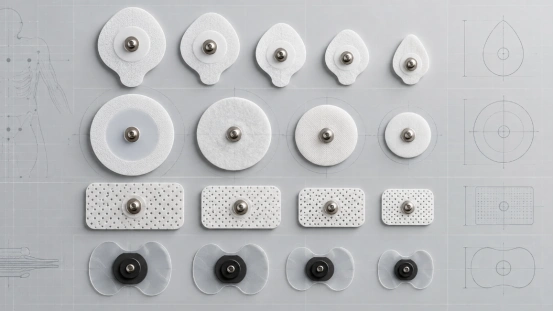
Common ECG electrode materials in the range include foam, cloth, medical tape, and Micropore. Compare flexibility, moisture handling, edge lift, removal feel, and storage limits. Request the hydrogel type, coating method, application pressure, dwell time, and validated wear duration.
For disposable ECG electrodes, ask for finished-product evidence covering irritation, sensitization, and cytotoxicity where relevant. Confirm latex-free and PVC-free statements in the material declaration. The evidence should cover the backing, hydrogel, adhesive, snap, and finished assembly.
Compare Snap and Lead Construction
Stainless-steel snaps and radiolucent snaps serve different workflows. Review mechanical retention, corrosion data, connector fit, and imaging instructions. A drawing is useful, but a mating sample often reveals small fit issues early. That small check can save a packaging change later.
How Can You Verify ECG Electrode Quality?
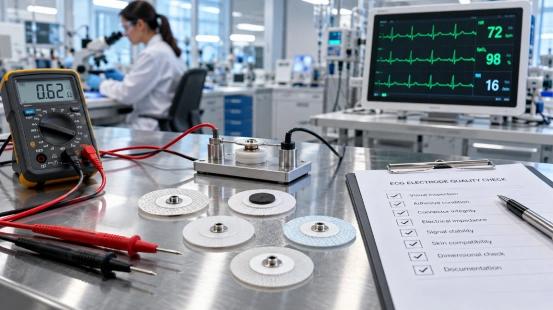
ECG electrode quality becomes measurable when the supplier connects each claim to a repeatable test. Ask for the test device, skin-preparation method, sample count, environmental conditions, wear duration, and acceptance criteria. You can then compare suppliers on the same ground.
Ask for Signal and Wear-Time Evidence
Review baseline noise, motion artifact, recovery after movement, contact stability, and replacement frequency. If impedance or contact quality is measured, ask how the reading was taken. Request lot-to-lot data and retention-sample rules as well.
A signal claim becomes procurement evidence when the test setup, sample group, conditions, duration, and acceptance criteria are named. Missing values should stay open on your qualification list.
Which ECG Electrode Certification Documents Should You Request?
Regulatory marks on a catalogue help you identify the supplier’s stated market coverage. They do not replace current documents. Build your review around certificate scope, product classification, legal manufacturer, validity dates, and destination-market rules.
Build an Evidence Pack
Request the ISO 13485 certificate, relevant CE documentation, FDA registration or listing information where applicable, MDSAP evidence where applicable, declaration of conformity, risk-management summary, and biocompatibility records. For sterile products, add sterilization validation, packaging integrity, and shelf-life data.
Regulatory documentation should be reviewed for the exact ECG electrode product and intended market. Ask the supplier to provide applicable certificates, declarations of conformity, and regulatory records, and verify their scope and validity before approval.
Ask About Standards and Changes
Ask which standards support disposable ECG electrodes in your destination market. If a supplier cites ANSI or AAMI EC12, request the current test report and the product scope. Keep registration, certification, listing, and test-standard claims in separate fields in your approval record.
What Should Your ECG Electrode Manufacturer Checklist Include?
Your ECG electrode manufacturer checklist should cover production controls as well as product performance. A sample may pass while a later lot drifts because a hydrogel batch, liner, snap, or adhesive source changed.
Review Manufacturing and Supply Controls
Ask how incoming materials are checked, how coating and die-cutting are controlled, and how snap attachment is inspected. Check lot coding, traceability, release criteria, retention samples, approved vendors, and engineering-change notification.
Then review monthly capacity by SKU, lead time, MOQ, packaging, storage temperature, shelf life, forecast rules, and business-continuity planning. These details matter when a hospital programme or device launch moves faster than expected.
Use a Weighted Supplier Score
Score application and signal fit at 20%, patient-contact materials at 15%, regulatory evidence at 20%, manufacturing controls at 15%, supply continuity at 15%, and commercial terms at 15%. Mark each item as verified, partially verified, or open. A clear score helps you see whether a low quote carries open technical work.
What Should an ECG Electrode RFQ Ask For?
An ECG electrode RFQ should give every supplier the same brief. Include intended use, patient group, wear time, electrode size, backing, hydrogel, snap, lead wire, connector, pack count, acceptance criteria, target market, sample quantity, test protocol, MOQ, forecast, lead time, shelf life, storage conditions, customization, tooling, Incoterms, and complaint handling.
For total landed cost, add freight, duty, inspection, storage, expected waste, replacement cost, and qualification work to the quoted unit price. The usable-electrode cost is the figure worth comparing.
How Does INTCO Medical Fit This Evaluation?
Once your use case and evidence list are clear, a supplier with several electrode formats can reduce the number of separate qualification paths you manage. INTCO offers disposable ECG electrodes for monitoring, diagnostic, stress-test, Holter-test, and selected imaging applications, as well as pre-wired formats. Confirm the intended use and compatibility of each model before selection. The range includes foam, cloth, medical tape, and Micropore options, plus stainless-steel and radiolucent snaps.
INTCO’s product documentation includes non-irritating, non-sensitizing, non-cytotoxic, latex-free, and PVC-free statements for its disposable ECG electrode product range. Confirm the supporting evidence and applicability to the exact model before making product-specific claims. INTCO’s available documentation includes ISO 13485 certificates and CE Declaration of Conformity documents for applicable product scopes. Confirm the exact product coverage, validity, and destination-market requirements before approval. You still need current certificates, product-scope confirmation, samples, and test reports for your market. The product information gives you a starting point for matching formats to your RFQ.
FAQ
Q1: What should you ask an ECG electrode manufacturer first?
A: Ask for intended-use fit, finished-product specifications, signal and adhesion test methods, current regulatory documents, samples, MOQ, lead time, shelf life, and change-control terms.
Q2: Which ECG electrode materials are common?
A: Foam, cloth, medical tape, and Micropore backings are common options, usually paired with conductive hydrogel and a metal or radiolucent snap. Confirm the finished-product specification for each model.
Q3: How do you compare an ECG electrode supplier fairly?
A: Use the same application, sample size, test method, acceptance criteria, document list, and commercial assumptions for every supplier. Score verified evidence separately from open claims.
Q4: What does ECG electrode certification prove?
A: Certification or registration supports a defined market, product scope, or quality system. Check the certificate number, validity, legal manufacturer, product coverage, and destination-market relevance.
Q5: What is the difference between Holter electrodes and stress test electrodes?
A: Holter electrodes need long-wear adhesion and a removal plan. Stress test electrodes need evidence from movement and perspiration. The right choice follows the workflow and test conditions.