








































AI in Medical Device Manufacturing: Where Automation Adds Real Value
AI in Medical Device Manufacturing: Where Automation Adds Real Value
FROM: INTCO Medical
|
16 Sep 2026
AI in medical device manufacturing now shifts from early pilot projects to everyday production tasks. The best results hardly ever come from replacing skilled operators. Instead, they happen by stripping away repetitive checks. They also help spot process drift early. Plus, they give engineers better production data.
For medical device manufacturers, the business case remains highly practical. You require steady output and traceable records. You also need quick reactions to defects. Above all, these processes must survive strict regulatory review. Automation adds true value here. It improves these outcomes when supported by appropriate validation, change control, and quality oversight.

Where Does AI Create Measurable Value in Medical Device Manufacturing?
AI works best alongside a clear, defined process. It also needs a steady data stream. A factory simply does not have to automate every single decision. Rather, it should pinpoint areas where tiny mistakes cause scrap or rework. These errors also cause downtime and compliance risk.
Quality Inspection Beyond Human Sampling
Older, traditional inspection largely depends on sampling. Operators look at a limited batch of units. They record the findings and report odd issues. This method still matters. However, machine vision can check a much bigger chunk of production.
AI quality inspection catches specific problems. These include surface marks and incomplete forming. It also spots dimensional variation, contamination, and packaging defects. A trained model compares each piece to normal visual patterns in milliseconds. Furthermore, the system builds a digital record. This directly supports long-term trend analysis.
Human review still matters. A practical setup uses AI to flag probable defects and lets trained staff confirm borderline cases. This reduces fatigue without giving an algorithm unchecked authority over product release.
Predictive Maintenance and Process Stability
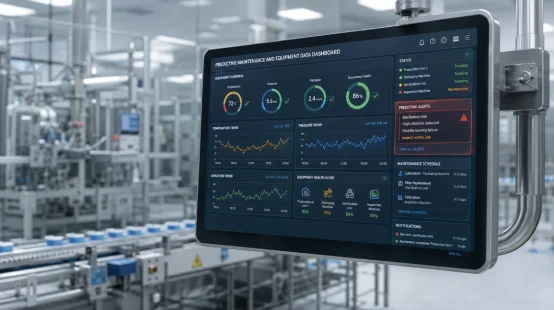
Unplanned downtime is expensive, especially on automated production lines with tightly linked steps. Predictive maintenance in medical manufacturing uses equipment data such as vibration, temperature, pressure, cycle time, and motor current to identify abnormal behavior.
The goal is not to predict the exact minute a machine will fail. The useful result is earlier notice that a component is moving outside its normal range. Maintenance teams can then schedule an intervention during planned downtime.
For example, a gradual change in forming pressure may point to wear, blocked airflow, or calibration drift. Addressing the cause early can prevent a larger batch from entering rework.
Which Production Tasks Should You Automate First?
A clear sequence helps you control risk. Start with tasks that are repetitive, measurable, and easy to verify. Avoid beginning with decisions that require broad clinical or regulatory judgment.
A Practical Automation Priority Matrix
|
Production task |
AI or automation fit |
Main benefit |
Key control |
|
Visual defect detection |
High |
Fewer missed defects and faster inspection |
Human review for uncertain images |
|
Equipment condition monitoring |
High |
Lower unplanned downtime |
Maintenance thresholds and alarms |
|
Batch record checks |
Medium to high |
Faster documentation review |
Audit trails and access controls |
|
Process parameter adjustment |
Medium |
Reduced variation |
Validated limits and approval rules |
|
Final product release decision |
Low for full autonomy |
Limited direct value |
Authorized quality personnel remain accountable |
Automated production lines can collect more information than manual systems, but more data does not automatically mean better control. You need consistent naming, time stamps, sensor calibration, and clear ownership of each data field.
Traceability as a Business Requirement
Medical device traceability connects raw materials, equipment settings, operators, inspection results, and finished batches. AI can help detect gaps in that chain, such as a missing inspection record or an unusual relationship between a material lot and defect rate.
This is especially useful when you operate several lines or sites. A data-driven medical device production system can show whether a problem is isolated to one machine, one shift, or one material supplier. That shortens investigation time and gives quality teams stronger evidence for corrective action.
How Can You Control Validation and Compliance Risk?
AI systems introduce a question that traditional automation does not: how do you prove that the model keeps working as conditions change?
Treat the Model as a Controlled Production Process
Your validation plan should define the model’s intended use, input data, acceptance criteria, failure modes, and change-control process. A vision model trained on one product color or lighting setup may perform poorly after a line change.
Keep a locked test set for periodic checks. Track false positives and false negatives. Record model updates with the same discipline used for equipment or software changes.
Regulatory compliance in medical manufacturing depends on documented control, not on the presence of AI. An explainable workflow is often more valuable than a complex model that no one can challenge or audit.
Keep People in the Decision Loop
Human oversight in medical manufacturing is not a sign that automation failed. It is a control for ambiguous cases and unusual events. Staff should know when to accept an AI recommendation, when to inspect the product manually, and when to stop the line.
Training should cover both product quality and system limitations. Operators need to recognize a sensor fault, a poor image, or a new defect that the model has not seen before.
What Data and Infrastructure Does AI Require?
Many manufacturers begin with a software purchase and discover that the harder work is data preparation. AI needs clean, connected information from machines, inspection stations, quality systems, and maintenance records.
Build a Small, Reliable Data Set
Start with one production line and one problem. Collect representative images or sensor readings across normal shifts, product variants, lighting conditions, and known defect types. Label the data consistently, then measure performance against a human-reviewed baseline.
A narrow project can reveal whether the available data is sufficient. It also exposes practical issues such as inconsistent camera angles, incomplete batch records, or sensors that need recalibration.
Cybersecurity and access control belong in the design from the start. Production data may contain sensitive operational information, and connected equipment can expand the attack surface.
Measure Results With Factory Metrics
Use metrics that finance, operations, and quality teams already trust:
- defect escape rate
- first-pass yield
- scrap and rework cost
- unplanned downtime
- mean time to repair
- inspection time per batch
- investigation cycle time
- audit finding frequency
AI implementation costs should be compared with these measurable outcomes. A system that saves inspection labor but increases validation work may not produce a positive return. The best projects improve quality and throughput at the same time.
How Can a Medical Device Supplier Support AI-Enabled Production?
AI delivers more value when the manufacturing partner already has disciplined processes, high-volume automation, and a strong quality system. The supplier’s role is not simply to install cameras. It must connect inspection, production control, material management, and traceability.
INTCO Medical operates manufacturing programs for disposable medical products, including examination gloves, surgical gloves, protective products, and related consumables. Its manufacturing operations incorporate automated production equipment, process monitoring, visual inspection, and documented quality controls to support consistent high-volume production.
For you, the relevant capability is the ability to scale controlled processes across large production volumes while maintaining documented quality checks. INTCO Medical operates manufacturing programs for disposable medical products, including examination gloves, surgical gloves, protective products, and related consumables. Its manufacturing operations incorporate automated production equipment, process monitoring, visual inspection, laboratory testing, and documented quality and traceability controls to support consistent high-volume production.
These established manufacturing and quality-control systems provide the process discipline and data foundation needed to evaluate future AI-enabled applications. Any use of AI-based inspection, predictive maintenance, or other intelligent manufacturing technologies should be validated for its intended application before being integrated into controlled production processes.
The practical question is how those systems connect to your specifications, acceptance criteria, and reporting needs. More information about its manufacturing scope is available through INTCO Medical.
What Should Your 12-Month AI Roadmap Include?
A measured rollout reduces disruption.
Months 1 to 3: Select and Baseline
Choose one high-volume process with a visible cost problem. Document current defect rates, downtime, inspection effort, and investigation time. Confirm data ownership and regulatory requirements.
Months 4 to 6: Pilot Under Supervision
Run the AI system beside the existing process. Do not use pilot results to release product until performance is stable and validated. Compare model findings with trained inspectors and record every disagreement.
Months 7 to 9: Connect to Quality and Maintenance
Link inspection alerts to nonconformance workflows. Link equipment alerts to maintenance planning. Set permissions so production staff can see actionable information without changing controlled records.
Months 10 to 12: Scale With Change Control
Expand only after the pilot meets agreed targets. Recheck performance after product, camera, material, or process changes. Keep a review schedule and assign a named owner for the model.
FAQ
Q1: Is AI in medical device manufacturing suitable for every factory?
A: No. It is most suitable where processes are repetitive, data is available, and defect or downtime costs can be measured.
Q2: Can AI quality inspection replace human inspectors?
A: Usually not. AI can perform consistent screening, while trained personnel review uncertain cases and retain release authority.
Q3: What is the quickest starting point for medical device manufacturing automation?
A: Visual inspection and equipment condition monitoring work best initially. Both utilize measurable inputs. They also provide distinct operational metrics.
Q4: How do you validate AI used in medical device manufacturing?
A: First, define the intended use of the AI system within the manufacturing process. Next, test performance using representative data. Document specific system limitations. Finally, manage model changes closely and keep the review process auditable.
Q5: What should you ask a medical device supplier regarding AI readiness?
A: Inquire about their automated production lines, inspection records, and traceability. Review equipment data, laboratory controls, and cybersecurity. Also, verify exactly how they validate process changes.