












































Previous
Disposable Glove Manufacturing Trends: Capacity Expansion and Material Innovations


If you buy gloves for a food plant or sanitation program, you already know the trap: the “cheapest” glove often ends up costing more once you factor in change frequency, downtime, and quality incidents.
Cost-effective gloves aren’t the ones with the lowest unit price. They’re the gloves that deliver the lowest total cost of ownership (TCO) per safe, compliant task completed.
Below is a practical, procurement-friendly framework you can use to compare options—and a real-world example of a newer material approach: INTCO Medical’s Synmax Pro Gloves.
In food handling and sanitation, food handling gloves aren’t a nice-to-have. They’re part of your control plan.
So the definition that holds up in procurement reviews is simple:
Cost-effective gloves = lowest total cost per task (e.g., prep, changeover, washdown, cold-chain pick/pack)
while meeting your fit-for-use requirements (dexterity, durability, barrier, comfort, compliance)
This shifts the conversation from “What’s the price per 100?” to “What does it cost us to run a shift reliably?”
Use a 1–5 score for each driver and compare gloves side-by-side. You don’t need a perfect model—just a consistent method.
Replacement rate is where “cheap” gloves quietly become expensive.
Look at:
average changes per hour (by task)
early replacements due to tears or discomfort
change patterns during washdown and changeovers
Procurement tip: Ask for data from a quick floor trial: gloves used per person per shift, by work area.
A glove failure isn’t just a glove.
It can trigger:
rework (redoing a task)
line interruptions
extra sanitation
increased waste
So you’re not buying “durability” as a nice feature—you’re buying glove durability that lowers disruption risk.
If a glove reduces grip or sensitivity, your team compensates by slowing down or double-gloving.
Score:
tactile feel for handling wet product/packaging
grip in oily or cold environments
whether operators keep them on (comfort drives compliance)
One glove rarely wins everywhere.
A strong procurement process defines “zones”:
food contact / prep: dexterity + comfort + consistent barrier
Sanitation/washdown: abrasion resistance and change frequency matter more
cold chain: elasticity and comfort under lower temps can affect breaks/tears
In regulated environments, documentation is time-consuming.
Evaluate:
material specs and traceability
relevant certifications and quality systems
consistent lot performance (ask how QC is run, not just what the spec sheet says)
A glove that’s “cost-effective” at the SKU level becomes a problem if it’s unavailable.
Score suppliers on:
production scale
multi-site manufacturing footprint
ability to support demand spikes without quality drift
Key Takeaway: A glove’s cost-effectiveness is dominated by replacement rate, failure cost, and supply continuity—not the per-box price.
This isn’t a one-material-is-best situation. It’s a fit-for-use decision.
Nitrile often wins when you need a strong combination of barrier performance and durability—especially in higher-risk or longer-wear scenarios.
Traditional vinyl can win on unit price for low-risk, short-duration tasks—but can lose on TCO when change frequency climbs.
Newer “hybrid” approaches aim to narrow the gap: keeping a vinyl-like cost structure while improving stretch, comfort, and durability.
That third category is where Synmax Pro Gloves is positioned.
If you see these, you’re likely looking at a higher total cost:
Operators regularly swap gloves mid-task because of micro-tears or poor fit
Supervisors approving double-gloving as a workaround
One SKU being forced into incompatible zones (e.g., using a light glove for heavy sanitation)
Frequent brand changes due to spot buying (inconsistent lots)
A supplier that can’t explain capacity or manufacturing footprint
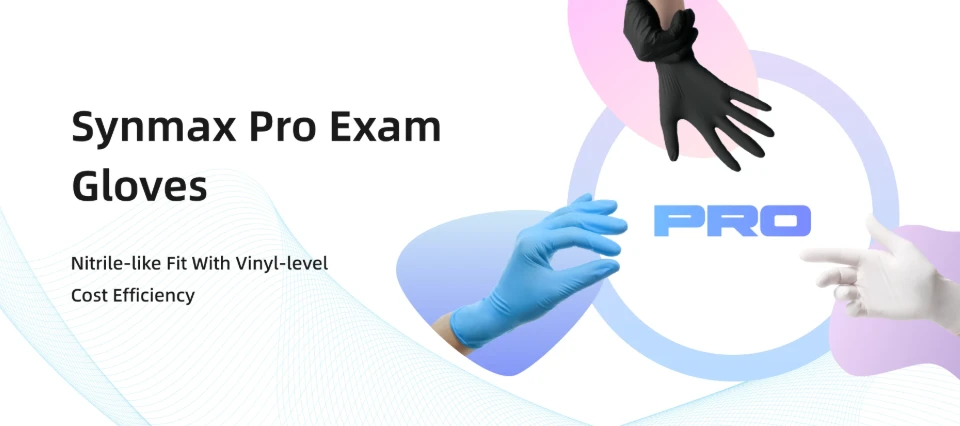
Synmax Pro Gloves is positioned as a high-volume glove option for teams that want a nitrile-like feel without paying a nitrile premium.
Here’s what INTCO states on its official product page:
Material: “Chemically Modified Vinyl-Based Formulation, Nitrile-Inspired” (Synmax Pro Gloves)
Value positioning: “Nitrile-Like Fit with Vinyl-Level Cost Efficiency”
Performance claims include “400%+ verified elasticity” and “10× Greater Than Nitrile Gloves” for abrasion resistance
Typical applications listed include food handling & preparation, cold chain, cleaning, and industrial tasks
Based on that positioning, Synmax Pro Gloves fit best when:
You’re running high glove consumption (where replacement rate dominates cost)
operators need stretch and dexterity (so they don’t constantly change gloves)
Abrasion during sanitation or handling is driving premature disposal
Run a short trial that measures what actually drives TCO (for Synmax Pro Gloves):
Gloves per shift (by zone)
Early replacement reasons (tear, discomfort, contamination event, etc.)
Task time impact (does dexterity change speed/accuracy?)
Incidents avoided (rework, sanitation resets, downtime triggers)
If a glove reduces changes and failure-driven swaps, a slightly higher unit price can still win on total cost.
Procurement teams often treat supply continuity as a separate issue from “cost.” It isn’t.
Stockouts create:
emergency spot buys
inconsistent specs/brands
Higher defect rates from unfamiliar products
operational disruption
INTCO emphasises scale as part of its ability to support a stable supply. The company’s annual production capacity is approximately 87 billion disposable gloves, including approximately 56 billion nitrile and 31 billion vinyl.
For high-volume food operations, that combination—scale plus multiple manufacturing bases—can reduce the hidden costs of shortages and vendor switching.
A “cost-effective” glove is the one that delivers the lowest cost per safe, compliant task—not the lowest price per box. In practice, your biggest levers are usually replacement rate, failure cost, and supply continuity. If you’re evaluating Synmax Pro Gloves or any other option, the most defensible approach is to run a short, measured floor trial by zone (prep, sanitation, cold chain) and track gloves per shift, early replacement reasons, and any time or incident impacts. Those few metrics will tell you far more about the total cost of ownership than a unit-price comparison ever will.
Start with cost per task. Run a short trial and record (a) gloves used per person per shift by zone, and (b) early replacements (tear, comfort, contamination event). Then multiply glove usage by your loaded unit cost and add a rough estimate for disruption (downtime, rework) when failures occur.
In many food plants, it’s replacement rate—because small differences in “gloves per shift” compound quickly across headcount and days. A glove that costs slightly more per piece can still win if it reduces change frequency.
Log replacement reasons during the trial. Split changes into (1) policy-driven changes (breaks, task switches, allergen/contamination control) and (2) performance-driven changes (tears, punctures, discomfort, loss of grip). The second bucket is where quality improvements show up in TCO.
Usually not. These zones stress gloves differently. Many teams reduce total cost by using a fit-for-use mix: higher dexterity for prep, higher abrasion resistance for washdown, and better elasticity/comfort for cold chain—then validating each with a simple zone-based trial.
Keep the comparison controlled:
Same shift, same tasks, same operators (as much as possible)
Compare against your current baseline glove in each zone
Track gloves per shift, failure/comfort reasons, and any task-time differences
Run long enough to cover normal variation (multiple shifts or multiple days)


